Sensory Processing Disorder, Daily Functioning, and ADHD
 Sensory Processing Disorder, Daily Functioning, and ADHD
The European Journal of Paediatric Neurology published research on sensory processing disorder, daily functioning, and ADHD. The study included 77 children, ages 8-11 years old (37 with ADHD and 39 typical controls). Each child was evaluated using the Conner’s Parent Rating Scale-Revised: Short Form (CPRS–R:S), the Short Sensory Profile (SSP) and the Children Activity Scale for Parents (ChAS-P). These tests were used to assess ADHD symptoms, sensory processing symptoms, and difficulties in daily function.
The results indicated the following:
- the Short Sensory Profile total score of the ADHD group was significantly lower than that of the control group.
- 65.8% of the children with ADHD had an abnormal Short Sensory Profile score indicating sensory processing disorder.
- only 2.6% of the typical children control group had an abnormal Short Sensory Profile score.
- the daily function of children with ADHD was significantly lower than in typical controls as indicated by the Children Activity Scale for Parents scores with the largest differences found in activities that require executive function skills.
- children with ADHD and abnormal Short Sensory Profile scores, had a significantly lower daily functional ability than controls.
- children with ADHD but normal Short Sensory Profile scores had only marginally lower daily functional abilities than controls.
- males had lower mean ChAS-P scores than females, however, these differences were statistically significant only among the children with ADHD.
The researchers concluded that sensory processing disorder may be a possible specifier of ADHD in children that is associated with functional consequences.
Reference: Mimouni-Bloch, A., Offek, H., Rosenblum, S., Posener, E., Silman, Z., & Engel-Yeger, B. (2017). Association between sensory processing disorder and daily function of children with attention deficit/hyperactive disorder and controls. European Journal of Paediatric Neurology, 21, e171.
Do you need simple handouts to help explain sensory processing disorder and how it can affect function? The What? Why? and How? series helps to explain different topics to students, parents, and teachers. Each hand out includes a definition of what the topic is, why it is important and how you can help.
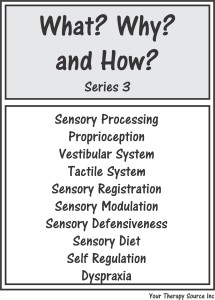
Series 3 includes one page hand outs on the following topics:
- Sensory Processing
- Proprioception
- Vestibular System
- Tactile System
- Sensory Registration
- Sensory Modulation
- Sensory Defensiveness
- Sensory Diet
- Self Regulation
- Dyspraxia